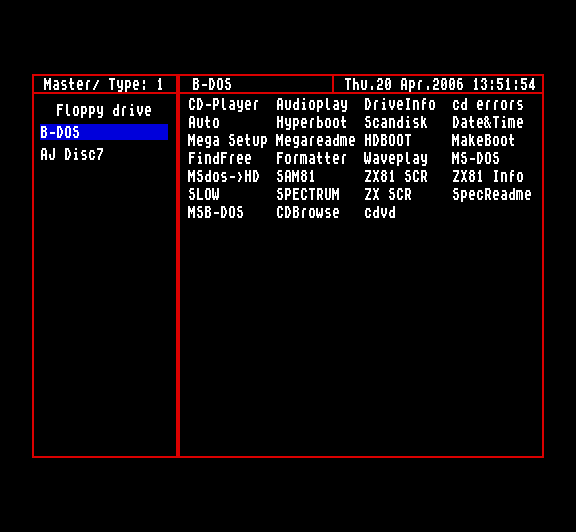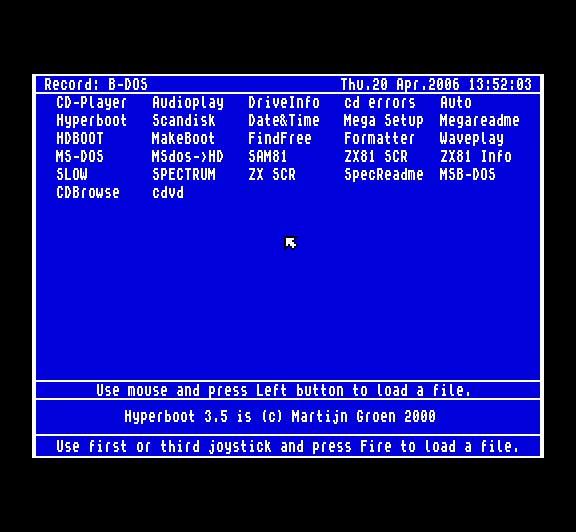
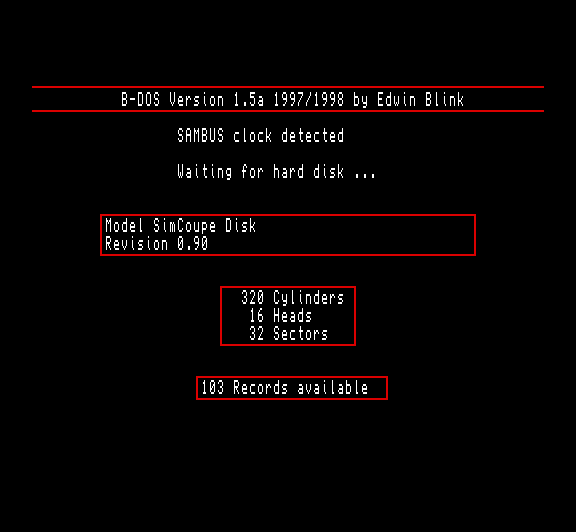
B-DOS is an improved SamDOS. B-DOS was originally written to use with a hard disk (using the ATOM internal hard disk interface) but has been forked to support the ATOM-Lite and the Trinity Ethernet Interface.
B-DOS can also be used without a hard disk but it only works with one disk drive.
B-DOS features:
- Faster verify (as fast as loading).
- VERIFY AT sector command
- Faster FORMAT (Formatting a disk takes about 66 seconds).
- Disks can be named with a 16 character name (file names remain at 10 characters).
- Date stamping (SAMBUS, Dallas clock and SAM Clock clock).
Versions and Compatibility
| 1.4e | 1.5a | AL 1.5a | 1.5t | 1.6 - 1.7 | |
|---|---|---|---|---|---|
| ATOM | ✓ | ✓ | ✓ | ||
| ATOM-lite | ✓ | ||||
| Trinity | ✓ (Beta 1-6) |
Edwin developed B-DOS for ATOM up to version 1.5a then Martijn Groen took over the development up to version 1.7q, adding boot utilities, CDROM/ATAPI support and B-DOS enhanced applications.
B-DOS AL 1.5a is a fork of version 1.5a by Edwin Blink to support the ATOM-lite CF interface.
B-DOS 1.5t is a fork of version 1.5a developed for SD card support on the Trinity Ethernet Interface by Colin Piggot. Further enhancements were made in later beta releases to support MMC and SD cards to increase the size of handled cards to 64 GB by Chris Pile.
The DOS version is given by the DVAR 7 variable manipulated by 'DOS type' and divided by 10.
DOS types are B-DOS = 0+10, SamDOS=0+0, MasterDOS =20+0
So for B-DOS 1.5, PRINT PEEK DVAR 7 is 5, minus 0, add 10 and divided by 10 gives 1.5.
For MasterDOS 1.4, PRINT PEEK DVAR 7 is 34, minus 20, add 0 and divided by 10 gives 1.4.
For SamDOS 2, PRINT PEEK DVAR 7 is 20, minus 0, add 0 and divided by 10 gives 2.0.
Note that the letter suffix is not represented in the version number so 1.7n will show the same version number as 1.7q. Additionally, when combined with MasterBASIC this increments the DOS version number
Hard Disc Support
B-DOS works with ATOM IDE hard disk interface and supports hard disks up to 8 GB. To make using a hard disk as user friendly as possible, the hard disk works like a virtual second disk drive.
The storage capacity of a hard disk is divided into 800 KB blocks. Such a 800 KB block is called a record and has the same format as a floppy disk, 2 sides with 80 tracks and 10 sectors per track.
Later B-DOS versions support IDE/ATAPI CD-ROMS on the ATOM.
ATOM-lite devices support only CF-cards due to the 8-bit bus.
Hard Disc Booting
The SAM Coupé can be booted by using a modified ROM3.0:
- from the ATOM using the HD Boot ROM;
- from Trinity Ethernet Interface using the Trinity Boot ROM;
- from Atom-lite using the ATOM-lite Boot ROM.
- from any Atom interface using ROM v4.0
Note that you will need to use the 'MakeBoot' utility to write a boot sector as part of the first RECORD so make sure you unprotect the record before you try or you will be unable to save it.